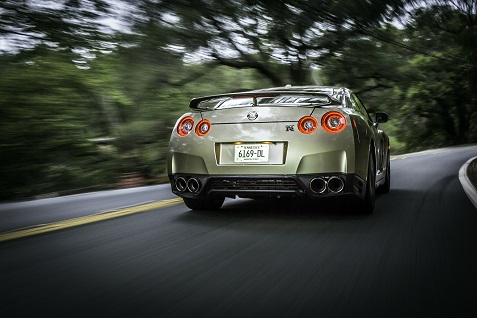
On standard cars, spoilers are those curved shaped things that usually swoop up from the rear of the car. Generally they are plastic or fiberglass and are affixed to the rear trunk lid. On race cars, they are much more elaborate. They might be huge affairs that rise up way off the car and on F1 Indy cars, they embellish just about every surface and just about touch the ground.
First thing to consider is why these things are called spoilers. To this author, it seems like a rather dumb name but it’s the term that has been used for years. A little research points out that because these devices “spoil” the natural airflow and that this is the name that has been used to indicate that. Well, regardless of the origin of the name, spoilers are very common devices on race cars and ordinary street cars. Let’s look at both categories.
F1 Indy Cars have front and rear spoilers which race car people often call “wings.” Their purpose is simple, at high speed they provide downward thrust which reduces the lift created by high speed driving and thus improves handling. Many people refer to the phenomena as “ground effects” because the downward push of the air flowing over the spoilers literally keeps the car anchored on the pavement. Handling is substantially increased.
The rear spoilers, Hoffman Chrysler reminds us, is a close cousin to the wings used on Indy race cars and on consumer cars serve a similar purpose. Although ordinary driving doesn’t provide a lot of downward thrust on a real mounted spoiler, it does provide a little and, let’s face it, they look kinda cool.
By the way, if there were a Rear Spoiler Hall of Fame, the Porsche 911 would probably take top honors. In 1974, Porsche replaced the more upright rear spoiler on its Carrera RS models with a monstrous device referred to as a “Whale Tail.” This design element was such a hit that it remained unchanged throughout the 70s and 80s. The whale tail was a perfect mix of engineering and aesthetics. It worked like it was supposed to, and it looked very cool while doing it.
In recent years, “active” rear spoilers have become popular on some sports cars. In 2013, BMW introduced one on their 3 Series Gran Turismo. The way it works is that at speeds of over 60 MPH, the rear spoiler electronically raises off of the rear truck and thus is said to provide 35% greater down force. The spoiler retracts flush with the bumper when speeds reduce to less than 40 mph.
But what about aftermarket spoilers, do they work as well? The answer is maybe. It really all depends on how good a spoiler it is and if its mounted correctly. If you are considering buying one for your car, look for a spoiler specifically designed for your make and model car. If you do, you will likely achieve positive results and your car will look great too.
